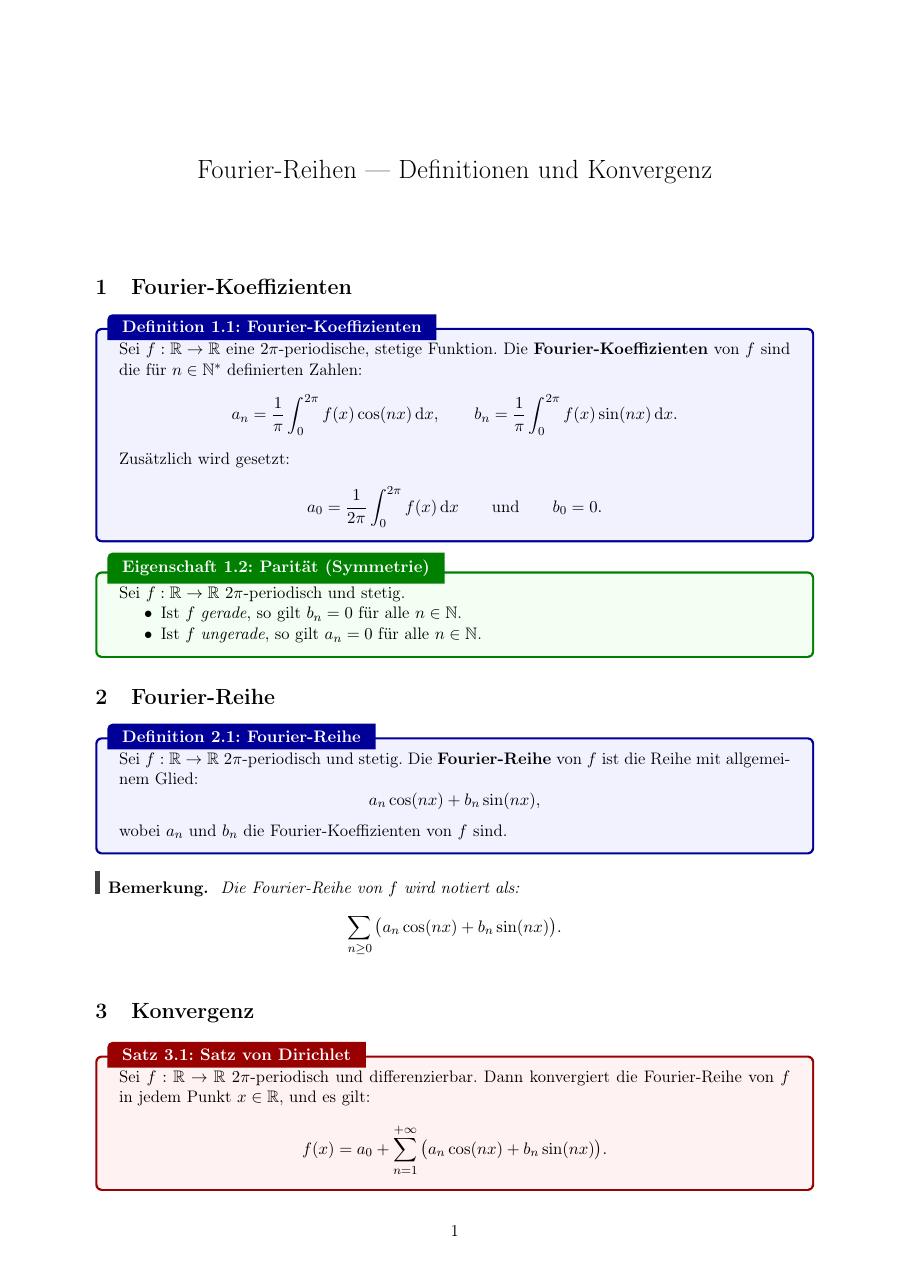
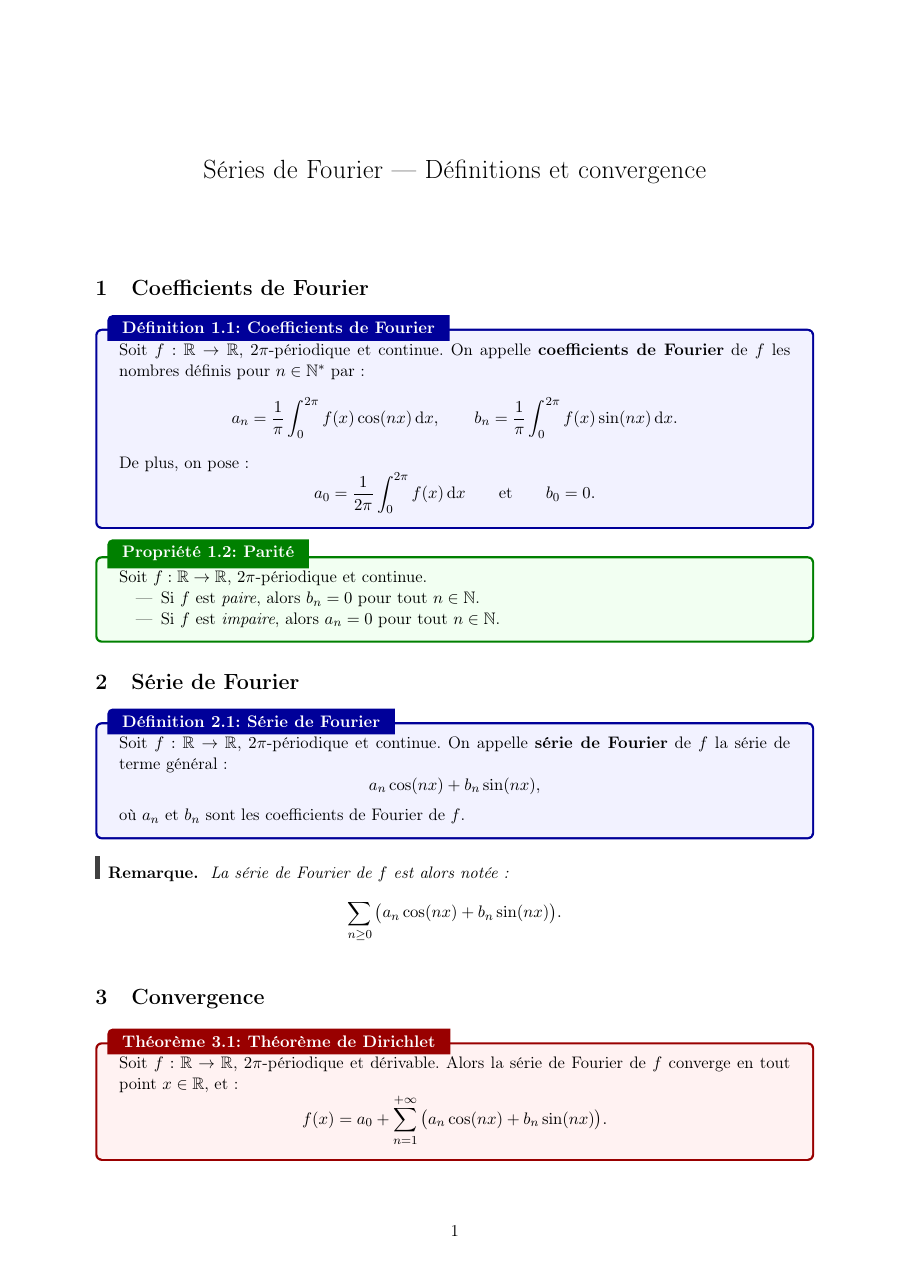
Short reference sheet on Fourier series at college / advanced calculus level: definition of Fourier coefficients (a_n, b_n, a_0), parity property (b_n=0 for even f, a_n=0 for odd f), formal definition of the Fourier series, Dirichlet's convergence theorem for 2π-periodic differentiable functions, plus the more general piecewise-C¹ form converging to (f(x⁺)+f(x⁻))/2. Numbered coloured boxes (Definition, Property, Theorem). Translated from a French engineering-school course.
\documentclass[11pt,a4paper]{article}
\usepackage[utf8]{inputenc}
\usepackage[T1]{fontenc}
\usepackage[english]{babel}
\usepackage[margin=2.2cm]{geometry}
\usepackage{amsmath, amssymb, amsthm}
\usepackage[most]{tcolorbox}
\usepackage{enumitem}
\usepackage[hidelinks]{hyperref}

\newtcbtheorem[number within=section]{definition}{Definition}{
  enhanced, breakable, colback=blue!5, colframe=blue!60!black,
  fonttitle=\bfseries, coltitle=white,
  attach boxed title to top left={xshift=8pt, yshift=-8pt},
  boxed title style={colback=blue!60!black, sharp corners, rounded corners=northwest}
}{def}

\newtcbtheorem[use counter from=definition]{theorem}{Theorem}{
  enhanced, breakable, colback=red!5, colframe=red!60!black,
  fonttitle=\bfseries, coltitle=white,
  attach boxed title to top left={xshift=8pt, yshift=-8pt},
  boxed title style={colback=red!60!black, sharp corners, rounded corners=northwest}
}{thm}

\newtcbtheorem[use counter from=definition]{property}{Property}{
  enhanced, breakable, colback=green!5, colframe=green!50!black,
  fonttitle=\bfseries, coltitle=white,
  attach boxed title to top left={xshift=8pt, yshift=-8pt},
  boxed title style={colback=green!50!black, sharp corners, rounded corners=northwest}
}{prop}

\newenvironment{remark}{%
  \par\smallskip\noindent\textcolor{gray!50!black}{\rule{3pt}{1.4em}}\hspace{0.5em}%
  \textbf{Remark.}\itshape\space%
}{\par\smallskip}

\title{Fourier Series --- Definitions and Convergence}
\author{}
\date{}

\begin{document}
\maketitle

\section{Fourier coefficients}

\begin{definition}{Fourier coefficients}{coef-fourier}
Let $f : \mathbb{R} \rightarrow \mathbb{R}$ be a $2\pi$-periodic continuous function. The \textbf{Fourier coefficients} of $f$ are the numbers defined for $n \in \mathbb{N}^*$ by:
\[
  a_n = \frac{1}{\pi} \int_{0}^{2\pi} f(x) \cos(nx) \, \mathrm{d}x,
  \qquad
  b_n = \frac{1}{\pi} \int_{0}^{2\pi} f(x) \sin(nx) \, \mathrm{d}x.
\]
We additionally set:
\[
  a_0 = \frac{1}{2\pi} \int_{0}^{2\pi} f(x) \, \mathrm{d}x \qquad \text{and} \qquad b_0 = 0.
\]
\end{definition}

\begin{property}{Parity}{parity}
Let $f : \mathbb{R} \rightarrow \mathbb{R}$ be $2\pi$-periodic and continuous.
\begin{itemize}[nosep]
  \item If $f$ is \emph{even}, then $b_n = 0$ for every $n \in \mathbb{N}$.
  \item If $f$ is \emph{odd}, then $a_n = 0$ for every $n \in \mathbb{N}$.
\end{itemize}
\end{property}

\section{Fourier series}

\begin{definition}{Fourier series}{serie-fourier}
Let $f : \mathbb{R} \rightarrow \mathbb{R}$ be $2\pi$-periodic and continuous. The \textbf{Fourier series} of $f$ is the series with general term:
\[
  a_n \cos(nx) + b_n \sin(nx),
\]
where $a_n$ and $b_n$ are the Fourier coefficients of $f$.
\end{definition}

\begin{remark}
The Fourier series of $f$ is then written:
\[
  \sum_{n \geq 0} \big( a_n \cos(nx) + b_n \sin(nx) \big).
\]
\end{remark}

\section{Convergence}

\begin{theorem}{Dirichlet's theorem}{dirichlet}
Let $f : \mathbb{R} \rightarrow \mathbb{R}$ be $2\pi$-periodic and differentiable. Then the Fourier series of $f$ converges at every point $x \in \mathbb{R}$, and:
\[
  f(x) = a_0 + \sum_{n=1}^{+\infty} \big( a_n \cos(nx) + b_n \sin(nx) \big).
\]
\end{theorem}

\begin{remark}
Under weaker assumptions (e.g.\ $f$ piecewise continuous and piecewise $\mathcal{C}^1$), the Fourier series converges to $\dfrac{f(x^+) + f(x^-)}{2}$ at every point. This is the most general form of Dirichlet's theorem.
\end{remark}

\end{document}