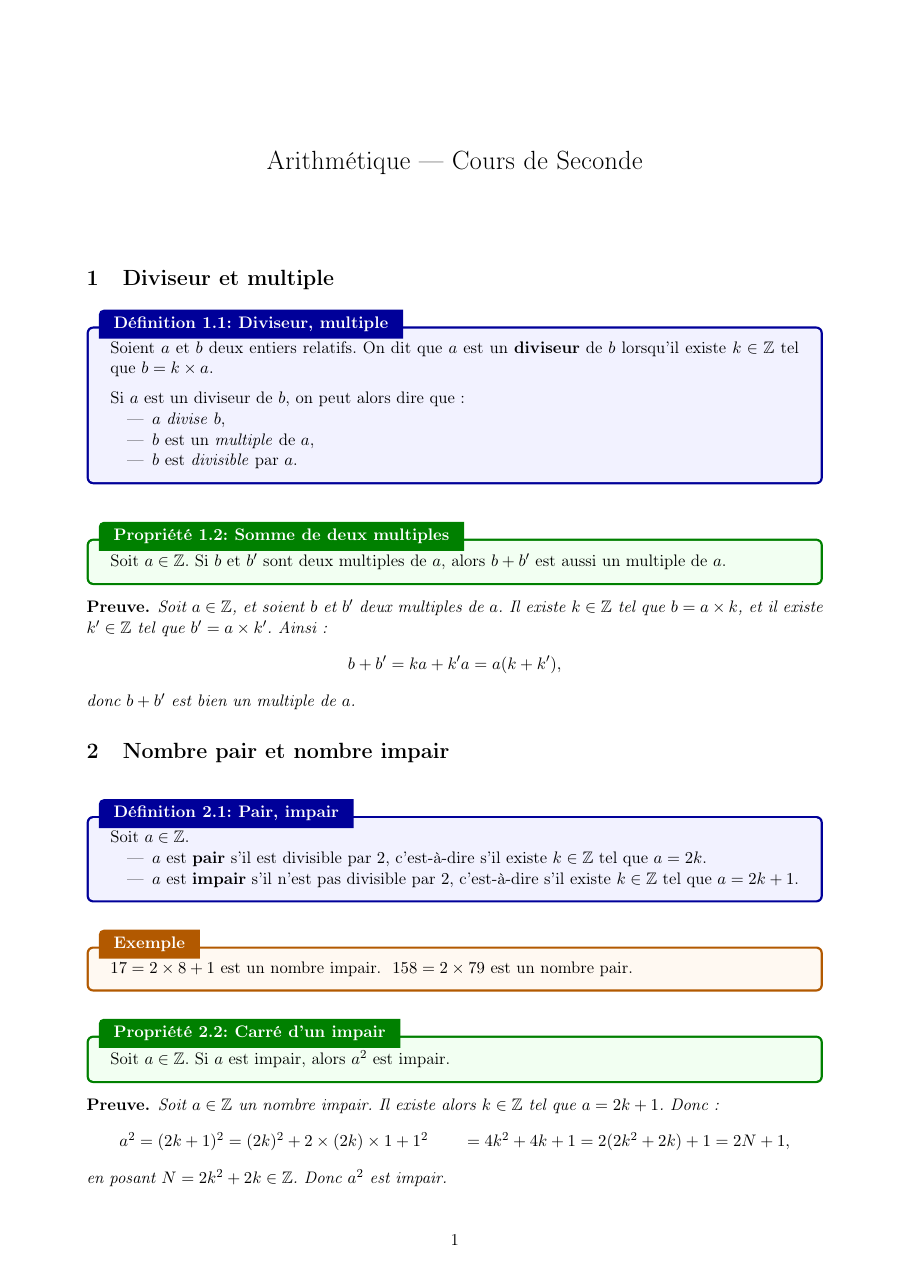
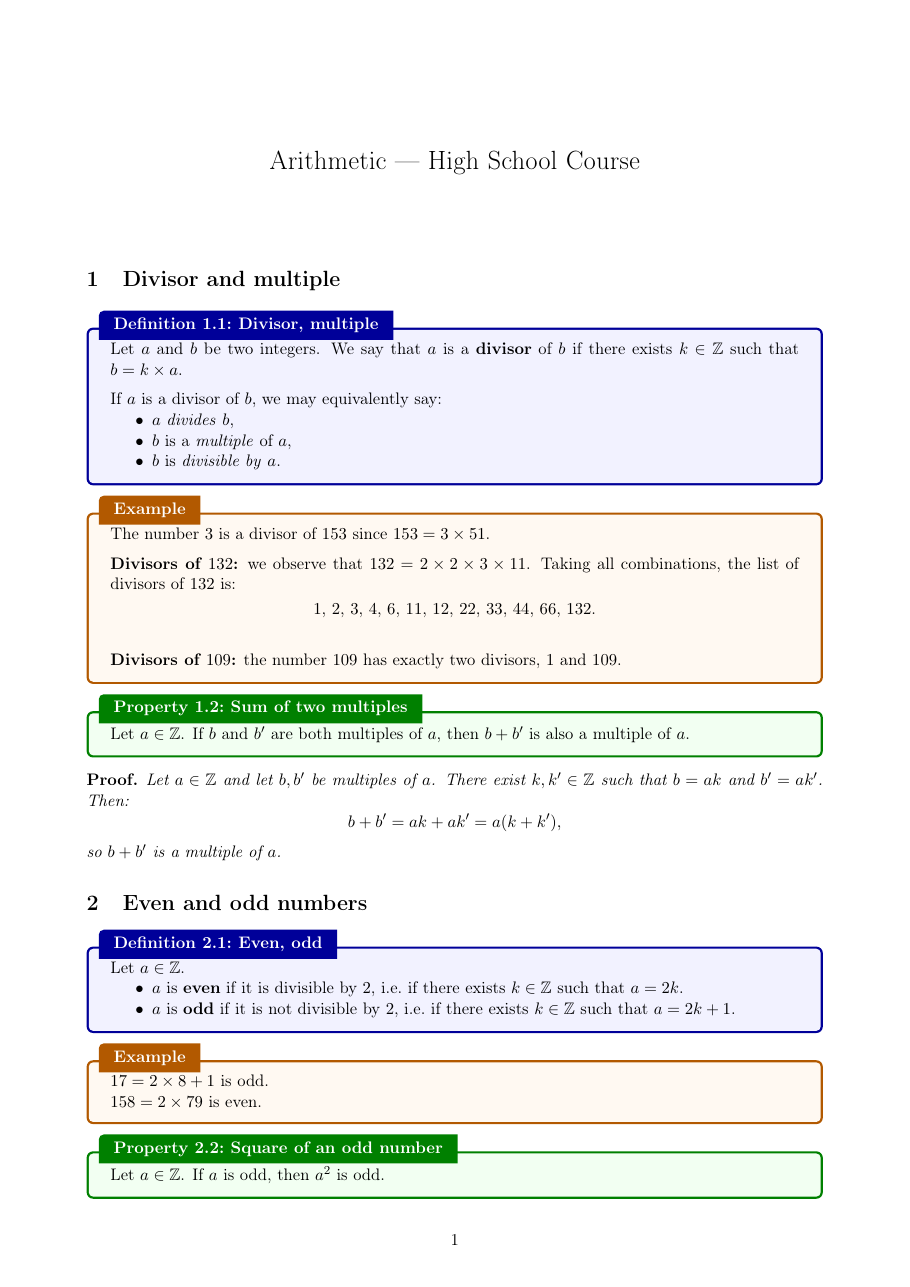
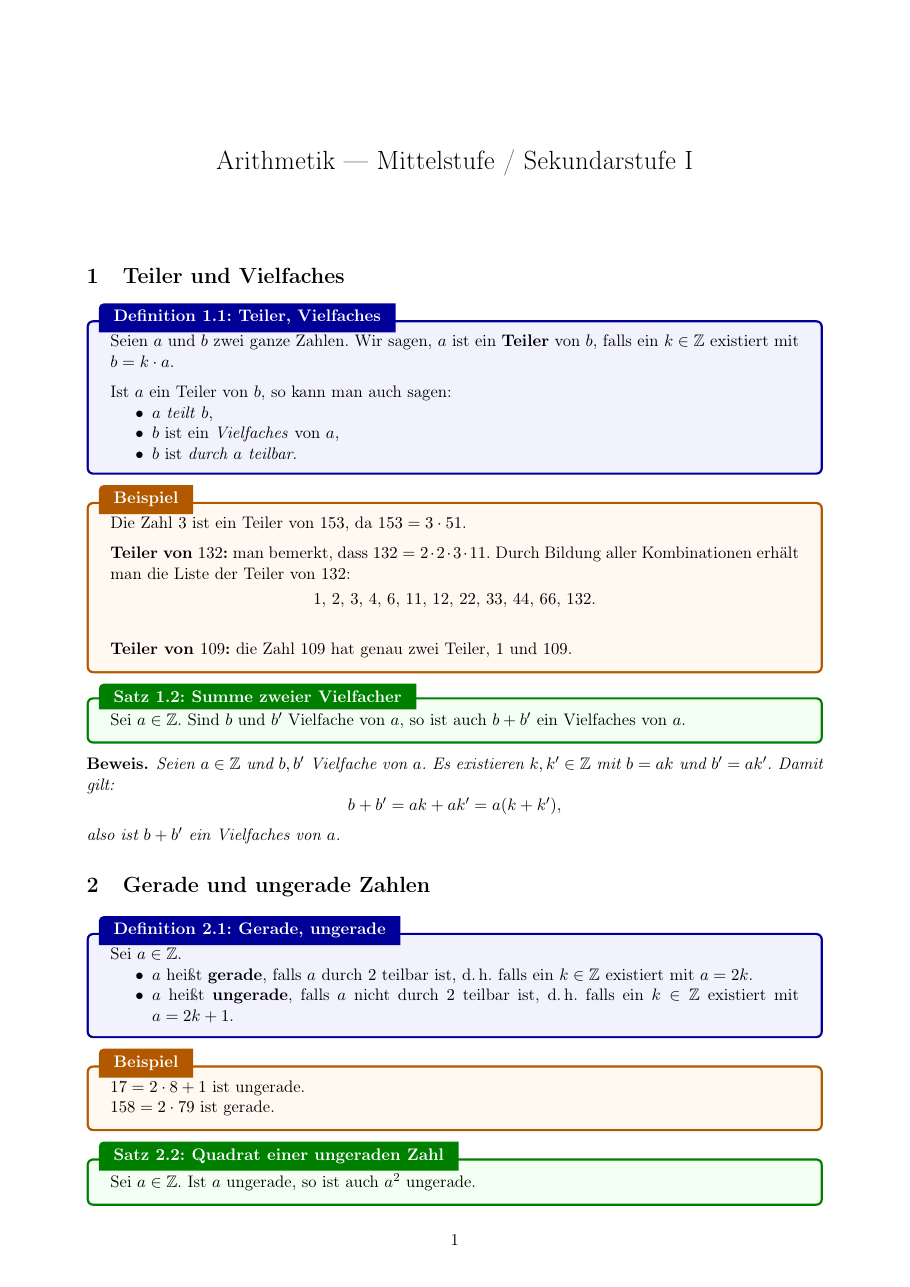
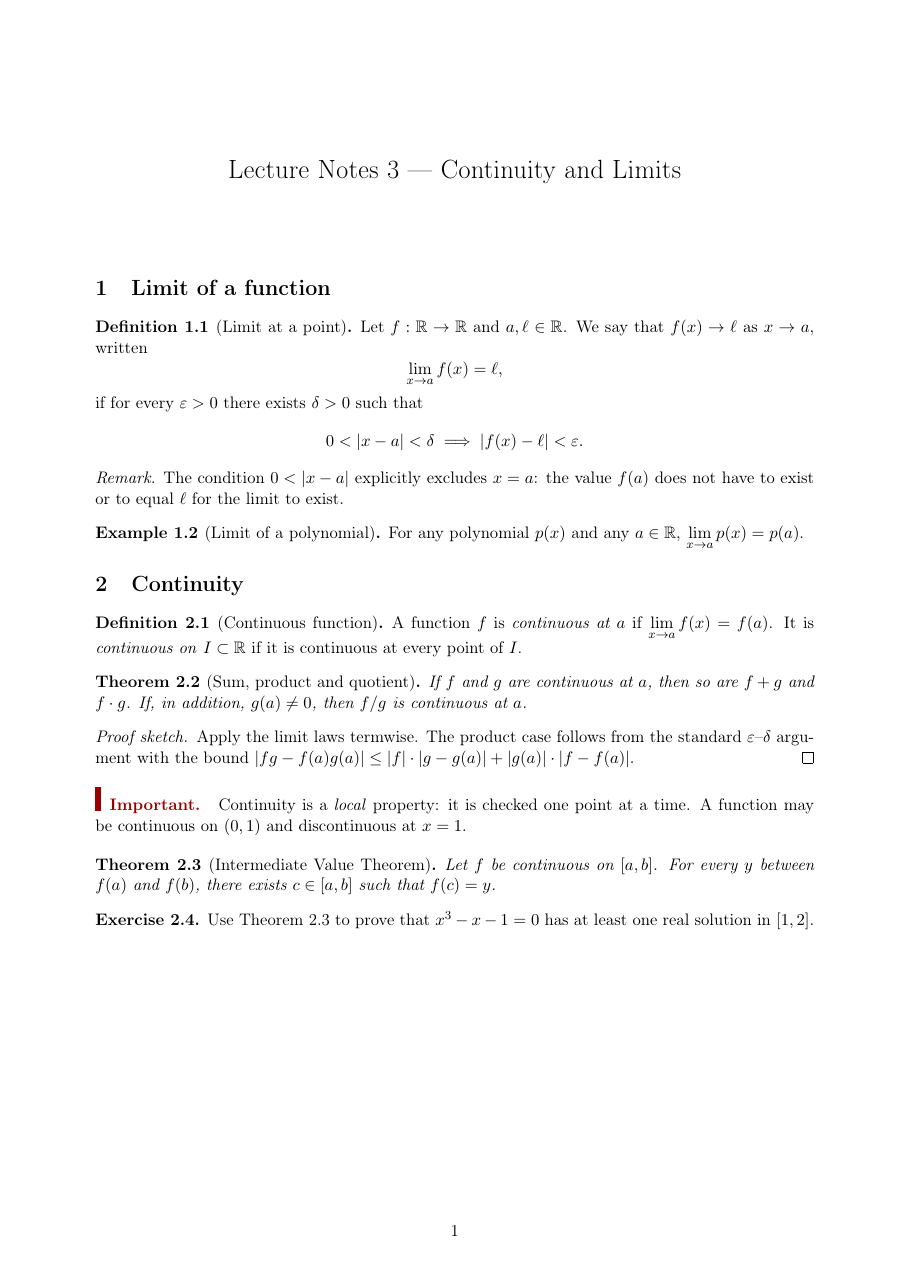
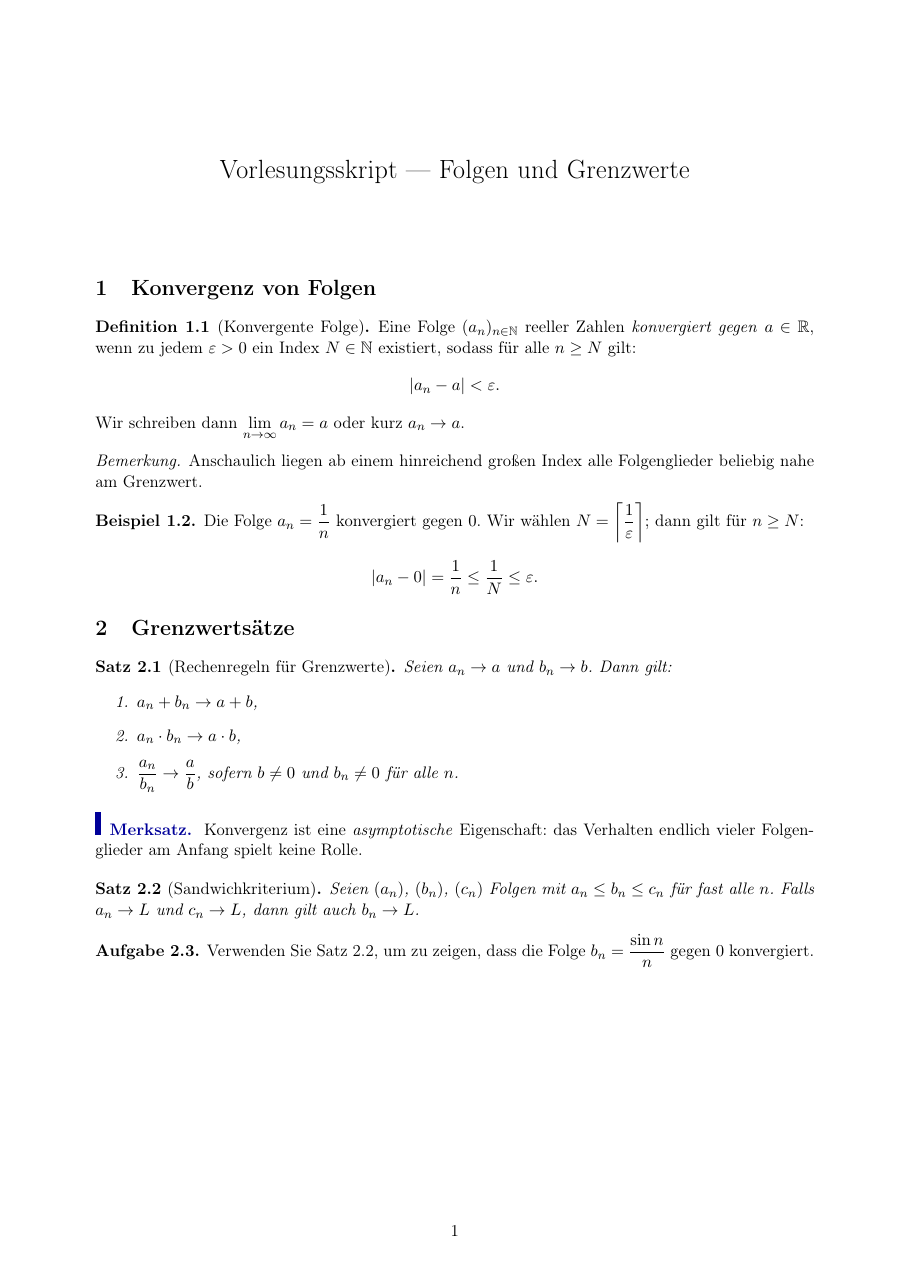
Modèle de cours de mathématiques niveau lycée avec boîtes colorées tcolorbox numérotées automatiquement par section : Définition (bleu), Théorème (rouge), Propriété (vert), Exemple (orange), Remarque (callout gris). Numérotation type 1.1, 2.1, 2.2 partagée entre toutes les boîtes mathématiques. Inclut un exemple de figure TikZ embeddée. Idéal pour profs de lycée qui veulent un rendu type manuel scolaire moderne.
\documentclass[11pt,a4paper]{article}
\usepackage[utf8]{inputenc}
\usepackage[T1]{fontenc}
\usepackage[french]{babel}
\usepackage[margin=2cm]{geometry}
\usepackage{amsmath, amssymb}
\usepackage[most]{tcolorbox}
\usepackage{tikz}
\usepackage{enumitem}
\usepackage[hidelinks]{hyperref}

% === Boîtes numérotées par chapitre ===
\newtcbtheorem[number within=section]{definition}{Définition}{
  enhanced, breakable, colback=blue!5, colframe=blue!60!black,
  fonttitle=\bfseries, coltitle=white,
  attach boxed title to top left={xshift=8pt, yshift=-8pt},
  boxed title style={colback=blue!60!black, sharp corners, rounded corners=northwest}
}{def}

\newtcbtheorem[use counter from=definition]{theoreme}{Théorème}{
  enhanced, breakable, colback=red!5, colframe=red!60!black,
  fonttitle=\bfseries, coltitle=white,
  attach boxed title to top left={xshift=8pt, yshift=-8pt},
  boxed title style={colback=red!60!black, sharp corners, rounded corners=northwest}
}{thm}

\newtcbtheorem[use counter from=definition]{propriete}{Propriété}{
  enhanced, breakable, colback=green!5, colframe=green!50!black,
  fonttitle=\bfseries, coltitle=white,
  attach boxed title to top left={xshift=8pt, yshift=-8pt},
  boxed title style={colback=green!50!black, sharp corners, rounded corners=northwest}
}{prop}

\newtcolorbox{exemple}{
  enhanced, breakable, colback=orange!5, colframe=orange!70!black,
  title=Exemple, fonttitle=\bfseries, coltitle=white,
  attach boxed title to top left={xshift=8pt, yshift=-8pt},
  boxed title style={colback=orange!70!black, sharp corners, rounded corners=northwest}
}

% Remarque : style "callout" simple, sans titre séparé en barre noire
\newenvironment{remarque}{%
  \par\smallskip\noindent\textcolor{gray!50!black}{\rule{3pt}{1.4em}}\hspace{0.5em}%
  \textbf{Remarque.}\itshape\space%
}{\par\smallskip}

\title{Géométrie repérée --- Cours de Seconde}
\author{}
\date{}

\begin{document}
\maketitle

\section{Repère du plan}

\begin{definition}{Repère orthonormé du plan}{repere-on}
Un \textbf{repère orthonormé} du plan est la donnée de trois points non alignés $(O, I, J)$ tels que :
\[ (OI) \perp (OJ) \quad \text{et} \quad OI = OJ = 1. \]
Le point $O$ est appelé l'\emph{origine}, et l'unité de longueur est $OI = OJ$.
\end{definition}

\begin{remarque}
Un repère orthonormé peut aussi être appelé \emph{repère orthonormal}.
\end{remarque}

\begin{exemple}
\begin{center}
\begin{tikzpicture}[scale=0.8]
  \draw[->] (-0.5, 0) -- (4.5, 0) node[right] {$x$};
  \draw[->] (0, -0.5) -- (0, 4) node[above] {$y$};
  \node[below left] at (0, 0) {$O$};
  \fill (1, 0) circle (1.5pt) node[below] {$I$};
  \fill (0, 1) circle (1.5pt) node[left] {$J$};
  \draw[help lines, dashed, gray] (0,0) grid (4, 3);
  \fill[blue] (3, 2) circle (2pt) node[above right] {$M(3\,;\,2)$};
\end{tikzpicture}
\end{center}
Le point $M$ a pour coordonnées $(3\,;\,2)$ dans le repère $(O, I, J)$.
\end{exemple}

\section{Distance dans un repère orthonormé}

\begin{theoreme}{Distance entre deux points}{distance}
Dans un repère orthonormé, soit $A(x_A\,;\,y_A)$ et $B(x_B\,;\,y_B)$ deux points. Alors :
\[ AB = \sqrt{(x_B - x_A)^2 + (y_B - y_A)^2}. \]
\end{theoreme}

\begin{exemple}
Calculons la distance entre $A(1\,;\,2)$ et $B(4\,;\,6)$ :
\[ AB = \sqrt{(4-1)^2 + (6-2)^2} = \sqrt{9 + 16} = \sqrt{25} = 5. \]
\end{exemple}

\begin{propriete}{Coordonnées du milieu d'un segment}{milieu}
Le milieu $M$ du segment $[AB]$ a pour coordonnées :
\[ M\!\left( \frac{x_A + x_B}{2}\,;\, \frac{y_A + y_B}{2} \right). \]
\end{propriete}

\end{document}